California
Having been a state since September of 1850, the people of California
were very much involved in the turmoil of America's Civil War.
Since the days of the initial gold discoveries, California had
grown enormously in size and importance to the support of the
national government. Gold helped to lubricate the great industrial
machinery of the East and now was needed to help finance the conflagration
then raging.
Since California was remote by comparison to the balance of the
then existing United States, travel to and from California was
very hazardous and difficult. One had two choices; the perilous
wagon journey overland across parching desert and past hostile
Indians or an equally uncomfortable journey by sea to Panama,
followed by a twenty-seven mile trek through steaming mosquito
infested jungle to the Pacific [or Atlantic] side there boarding
another oceangoing vessel to points north. The gold was shipped
"round the horn" of South America by Pacific Mail Steamers.
The United States Government, in order to
protect these important migratory and commerce routes, had stationed
about thirty-five hundred Regular troops about the west; from
remote blockhouses in Washington Territory to lonely, arid, sand-blown
posts in the deserts of the Arizona Territory; and at many points
around California, from the Docks at Benicia to the waters of
the Colorado River.
When the fighting erupted in April of 1861,
the California Legislature declared the State for the Union (even
though some of the "Placer" and southern counties had
decidedly southern leaning populations) and pitched in with raising
volunteers for the cause. By December of 1861, California had
raised two regiments of cavalry and five regiments of infantry
for the Union. Later, three more infantry regiments would be enlisted
along with a battalion each of "Mounted Infantry" and
"Native Cavalry" for a grand total of sixteen thousand
plus Californians enlisting as volunteers during the war. This
was a sizable amount for a fledgling state far from the core.
As the Volunteers were mustered into service they replaced the
Regular United States troops as they were drawn off to the center
of the war to fight.
All of the troops raised in California as
volunteers served in the west at the places previously manned
by the small force of Regulars with a few new additions [Drum
Barracks being one of the most important additions]. The government
deemed this necessary in order to keep California safe for the
Union because of a fear of a possible Confederate takeover. In
fact, only a small detachment of cavalry with the California Column
ever had fighting contact with actual Rebels. The main hazards
to the California Volunteers were Indians, hostile locals, and
hostile environmental conditions. These volunteers suffered as
many a privation as their eastern counterpart but without the
chance for the battle glories dreamed of by the soldiers of the
day. This was a source of great consternation and regret by many
of the California Volunteers. Some claimed they were misled when
they enlisted, and a great deal of grumbling ensued. There were
some desertions, but the great many of the volunteers did their
promised, and no less important, duty till their terms expired.
 Detail from California Soldier's
Bounty Warrant
Detail from California Soldier's
Bounty Warrant
(Author's collection)
The Hundred
News from the front was not encouraging for Union men during the
summer and fall of 1862. The realization that this would be no
flash in the pan fight was setting in. In San Francisco during
this time a local militia officer, J. Sewall Reed, along with
others were hatching a plan to get themselves and other Californians
to where the fighting was. The group had friends in high
places in the Bay State and managed to get the ear of Governor
John A. Andrew. They proposed to raise a company of a hundred
handpicked men in California to serve as a company in a regiment
of cavalry then being raised for the Massachusetts quota. An arrangement
was reached in favor of the venture as long as they provided their
own transportation to the East. In the fall an advertisement appeared
in a San Francisco newspaper:
Cavalry Company for the East
THE UNDERSIGNED HAS RECEIVED
authority from the Secretary of War to
raise a company of Light Cavalry for
service in the East to form part of the
Massachusetts quota.
A Roll for the company is at Assembly
Hall, corner of Post and Kearny Streets,
where persons desirous of joining can
enroll their names.
No one need apply unless he is a good
horseman and in perfect health. Men
from the country preferred.
All expenses will be paid as soon as accepted.
Further information can be obtained
at the recruiting booth.
s/ J. Sewall Reed
Many were said to have applied but only
the hundred most skilled were accepted to enlist. By early December
the ranks were filled and on the eleventh, after pooling their
bounty money to pay for transportation offered at half price by
the Pacific Mail Steamship Company, the "California Hundred",
amid cheering crowds, steamed out of the Golden Gate on the Steamer
Golden Age bound for Panama. Upon reaching Panama a cog railway
was taken across the isthmus to Aspinwall where they boarded the
Ocean Queen for New York.
The California Hundred arrived in New York
at 2a.m. January 3rd, 1863, after a less than pleasant trip in
crowded conditions with very poor fare. They were met at the dock
by the "Sons of Massachusetts" welcoming committee and
escorted to the New England Rooms for a well-appreciated breakfast
and dinner. That evening they were again aboard ship bound for
their sponsor city, Boston. After more cheers and welcoming The
Hundred were sent to Camp Meigs at Readville, Massachusetts for
training, here they officially became Company A of the 2nd Massachusetts
Volunteer Cavalry.
Training at Camp Meigs was not as mundane
for The Hundred as for most other troops. They had many visitors,
as the Easterners had a curiosity to know what the Californians
were like. Their unique hat brass, a set of downward crossed dragoon
style brass sabers along with brass letters CAL 100 in a semi
circle over the top, was mentioned by George Towle in his Recollections
as having "served as a regulation pass when we visited Boston."
The evening of January 13th, a surprise party was given at The
Hundred's barracks by the Bunker Hill Association of Charlestown,
Massachusetts. This banquet was held to honor the Californians
for their patriotism and, the presentation of an American Flag
by a Miss Abbie Lord. After Miss Lord's speech, Captain Reed accepted
the standard on behalf of his Company. Too large for cavalry service,
the flag was only used once during the war. Sadly, it served only
to shroud the body of the Captain whose eloquent acceptance speech
brought the Barracks to cheers and song long into the evening
that night. The very next morning it was off to Boston where more
feting awaited. The Mayor of Boston received them at the City
Rooms, Governor John Andrew at the State house, and ending the
day with a "bountiful collation" at Faneuil Hall.
Upon returning to camp January 27th, after
a company wide ten-day furlough, The Hundred were issued their
horses and equipment. From this point until their departure for
Virginia, on February 12th, they were involved in constant training
and drill. Company A arrived at their first camp, Gloucester Point,
Virginia, across the river from Yorktown on February 22, 1863,
along with Companies B, C, D and K under the command of Major
Caspar Crowinshield. The boys from California had received their
wishes; they were now in position to see the "Elephant"
and do something about it!
During The Hundred's stay in the Peninsular
Arena they were mostly involved in scouting and picket duty. Their
assessment of the manner in which they were being used was cause
for much complaint and criticism of their officer's competence.
As westerners they knew you didn't catch bushwackers by riding
up and down the beaten path. Their familiarity with Indian style
warfare made them good judges in this concern and, unknown to
them at this time, well suited for their future duties. However,
their ignorance of military protocol was cause for some rough
times in the beginning of their service.
The Hundred's first big test came during
a June expedition to burn the bridges across the South Anna River.
In a dismounted charge, across the water and into the fortifications
of a detachment of the 44th North Carolina, "seventy Californians
and twenty Massachusetts men captured one hundred and twenty-three"
Carolinians, officers and all. Now baptized by Mars they watched
the bridge burn and fall into the water, their elation checked
by the lifeless body of Joe Burdick and the cries of two seriously
wounded comrades.

Captain J. Sewall Reed
(USAMHI)
The Battalion
The enthusiasm started by the raising of The Hundred was still
going strong in San Francisco after their departure. There were
many men who didn't make the first cut that still wanted to go
to war. De Witt Clinton Thompson, a charter member of the First
California Guard and member of General Halleck's staff, felt he
could raise a battalion of four companies for service in the east
in the same manner as Captain Reed. Massachusetts Governor Andrew,
having some troubles filling his quotas, readily agreed. On January
15th, 1863, Thompson received permission from the Secretary of
War. The next day a notice appeared in the Alta California requesting
enlistees for
"…three years or the war,
under the Massachusetts Quota,
and will leave for New York on the 11th of February next.
Transportation has now been provided for and sufficient funds
are now under the control of hon. Ira P. Rankin to pay all
necessary expenses of the organization. Uniforms, quarters,
substinence and necessary outfit will be furnished to the men
as soon as accepted."
Appointed Major by Governor Andrew, Thompson had fifty applicants
by the 19th. However, February 10th, the day before Thompson first
proposed to sail, only one hundred eighty-five enlistees were
on hand. The departure date was postponed and additional recruiting
offices were opened. The enlistees bunked at Platt's Music Hall
and drilled daily in addition to making an impressive showing
at a few parade and reviews.
On March 20th and 21st, the volunteers were
mustered into service. There were only three complete companies
ready to sail on the steamer S.S.Constitution March 23rd.
Captain David A. De Merritt stayed behind to complete recruiting
his company and did not reach Boston until mid May. Those that
sailed that beautiful clear March day were treated to the "traditional"
parade, speeches, and salutes. Throngs cheering from the shore
and boats must have offset, temporarily at least, the trepidations
one should feel when going to war. It was another wonderful send-off
for the patriots from California even though it belied what waited
ahead.
The voyage aboard the S. S. Constitution
was miserable and a stop had to be made in Mexico to take on fresh
provisions to quell insurrection. Guard duty caused the Battalions
first casualty. Hiram Townsend of Walnut Grove fell overboard
while on guard duty one evening leaning on a rail while seasick.
Feelings during the voyage were not improved as the Californians
thought the steamer's crew made but a "trifling search."
For the Atlantic side of the trip The Battalion boarded the same
ship that conveyed The Hundred, the Ocean Queen. The Alta
California newspaper reported the Battalion debarking the
Ocean Queen at New York cursing the vessel, her captain
and all connected with Vanderbilt's steamship line. The New York
welcoming committee consisted of a few hack drivers, two newspaper
boys, some old women selling apples and a Sheriff with a writ
of habeas corpus freeing 18-year-old Isaac Golinsky, who had wanted
to "back out" at the last moment before sailing, from
service. Although this was not the welcome they had expected,
a nice meal and show that evening improved The Battalion's mood.
The next day, after a parade and speech by Governor Nye of Nevada,
they were off to Camp Meigs at Readville, Massachusetts for training
and designations as Company E, under Captain Charles Eigenbrodt;
L, under Captain Zabdiel Adams; F, under Captain David De Merritt;
and M, under Captain George Manning.
Hard fighting had cooled the Easterners
taste for war and the fanfare enjoyed by The Hundred a few months
earlier didn't materialize for The Battalion. There was some resentment
of this as they had come so far to fight, and possibly even die,
for their country. Even worse feelings were instilled when Governor
Andrew paid more attention to his first "Negro Regiment"
the 54th Massachusetts, also training at Camp Meigs, than to the
Californians.
The Battalion received marching orders May
12th, and feeling they had been poorly treated, were glad to leave
Massachusetts. Arriving in Washington City May 16th, they were
attached to the 22nd Army Corps. For their first weeks of service
they did scouting duty around the city. During June they were
moved from East Capitol Hill to Camp Brightwood for picket and
patrol duties in the region between Washington and the Blue Ridge.
The Battalion's first real taste of the
"Elephant" came on July 12th, while on a reconnaissance
mission of the Shenandoah Valley with Colonel Charles Russell
Lowell.
The Californians pursued three platoons of Confederate Cavalry
to Ashby's Gap where a hot fight ensued. After an initial charge
by the Californians was turned back, Colonel Lowell sent two companies
of Californians to turn the left flank. The rebels were forced
to fall back and were chased for three miles. With the weather
poor for visibility the expedition turned back to their base.
As it was with their predecessors, The Hundred, The Battalions
first taste of victory on the field was tempered with the reality
of war and its fortunes. During this "successful" action
Walter S. Barnes and Harry P. Irving were killed, another mortally
wounded, four others slightly wounded, and Lieutenant John C.
Norcross and three privates captured. All were Californians.
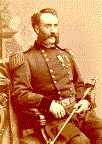
Major D.W.C. Thompson
(Post war image, author's collection)
The Regiment
On August 6, 1863 The Hundred and The Battalion were finally united
along with the rest of the regiment at Centerville, Virginia.
For the next year the 2nd Massachusetts Cavalry would operate
in the area of Virginia fast becoming known as "Mosby's Confederacy";
Fauquier, Loudoun, and Fairfax Counties, Virginia. John Singelton
Mosby, a protégée of J.E.B. Stuart, with a group
of "Partisan Rangers" began harassing the Union installments
in the area in a series of lightning like strikes. After a raid,
Mosby's Rangers would scatter to the wind making retribution almost
impossible. Mosby's men knew the country and the sympathetic inhabitants
giving them a great advantage over their cumbersome foes.
The Californians were well matched for this
duty as their skills as horsemen and gunmen were on a par with
their new antagonists. However, they were again immensely frustrated
as they felt the Command just didn't understand how to properly
counter "guerrillas". Their officer's predictable folly
of following the highways while on scouting expeditions led to
at least two major disasters during 1864; Dranesville in February,
and, Mount Zion Church in July. In each of these fights with Mosby
the Californians suffered heavily during surprise attacks resulting
in several killed, many wounded and scores hauled off to the horrors
of the Confederate prison camps. Yet, despite the impossible task
and handicaps handed to them, The Californians performed their
duties with honor and éclat, even winning the admiration
of their foes. Ranger Munson, in his Reminiscence's, stated:
"…his[Capt. Reed, Dranesville] men began breaking
through the fences and into the fields, but fighting all the while…His
Californians, especially notoriously good fighters, were standing
up to the rack like men, dealing out to us the best they had.
They rallied at every call on them and went down with banners
flying."
In spite of these setbacks, the situation
was not a comfortable one for Mosby's men either. In several clashes
with the 2nd Massachusetts Cavalry, Mosby ended up on the short
side losing many of his best and brightest subordinates. Mosby
himself was almost killed in the Coyle's Tavern raid carrying
home two Californian bullets in his thigh and groin that deceptively
pleasant August 24th, 1863.
During July of 1864, General Jubal Early
crossed the Potomac with his Rebel Army and made an advance on
Washington City. The Californians and the Bay State Boys were
placed in position to reconnoiter and contest his advance. Along
one thoroughfare a hand full of Californians from Company M, and
Massachusetts's men from Company D, were the only troops between
Early and the heart of the Capitol. Details of the Regiment gallantly
stood at the Monocacy River fords, Fort Reno, and Fort Stevens
to slow the advance and buy time for reinforcements. When Early's
advance was checked, he withdrew, but not before the entire 2nd
Massachusetts Cavalry ripped into his Army's coat-tails with their
new Spencer repeating carbines in a fierce seesaw fight at Rockville,
Maryland. They had seen him in, and it was only polite to see
him out!
The late summer of 1864 brought a welcome change for the men of
the 2nd Massachusetts Cavalry. General Grant had enough of Early
and the cozy avenue he used to stroll up to the Capitol, the Shenandoah
Valley. This area had provided food and cover for the enemy since
the beginning of the war. General Philip Sheridan was given the
helm of a new force, the Army of the Shenandoah, and charged with
destroying Early, his Army and his breadbasket. August found the
2nd Massachusetts Cavalry on the move for twenty-one days straight
while constantly fighting and performing bravely. The Regiment
was riding high in the saddle fighting with "Little Phil".
They were happily on the offensive now and the bushwhacking business
was behind them. At August's end several more of California's
bravest troopers had joined the ethereal ranks of Captain Reed
and the others. The dashing Captain Charles S. Eigenbrodt was
shot dead from his horse in a charge at Halltown on August 25th,
and gallant Lieutenant Charles E. Meader was killed the next day
in a "hand to hand fight" at Charlestown, while in command
of The Hundred.
September brought the 2nd Massachusetts
a welcome honor. They were made a part of Sheridan's Reserve Brigade
of Cavalry along with two Regiments of U. S. Regulars. As icing
on the cake their Colonel Lowell was appointed Brigade Commander.
Fighting took place all that month and into the next with battles
at Opequan creek, Locke's Ford, Winchester, Waynesboro, Round
Top and Tom's Brook.
Early October the Regiment was ordered to
burn all forage and confiscate all supplies in the Valley. The
order was carried out so well that, within four days of the order,
fodder had to be shipped in for the Regiment's horses. An angered
Early struck back on October 19th, at Cedar Creek and nearly had
his way if not for a stubborn stand by the Cavalry Corps and part
of the 6th Corps. With his Army recovered in the afternoon Sheridan
attacked and Colonel Lowell and his boys shined. Charge after
charge finally broke the back of Early's Army, and again, the
Spencers of the 2nd Massachusetts helped usher him off. The toll
this time was heavy, Brave Colonel Lowell was dead, as was Captain
Rufus Smith while leading the surviving members of The Hundred.
Ten of the Regiments own died that day along with twenty-two wounded.
After Early's expulsion from the Valley,
the Regiment stayed in the area doing picket and patrol duty until
February. The high point during this time was an ordered raid
into Loudoun County to burn and forage that must have satisfied
many as this area had given Mosby so much aid during past clashes.
The low point was a freezing march toward Gordonsville and back
during mid December.
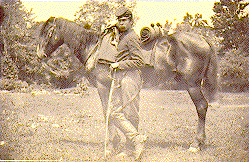
18-year-old trooper Waldo Le Fay and mount
2nd Massachusetts Volunteer Cavalry
(Author's collection)
The End and Beyond
Battle scarred and worn, the Californians joined one of the hardest
marches of the war when Sheridan left Winchester for Petersburg
February 27th, 1865, to join the Army of the Potomac in its campaign
against Lee. After destroying the remnants of Early's Army, the
Cavalry Corps literally worked their way east. For the next month
the Regiment marched, fought, skirmished and destroyed all that
could be of use to the enemy for almost three hundred miles. The
entire journey made worse by unrelenting rain and torturous mud.
Arriving in camp at Petersburg they were
but three days at rest before they were back in the saddle again.
This time, unbeknown to them, they were to play a pivotal part
in the last chapter of the Rebellion.
March 31st, the 2nd Massachusetts Cavalry
participated in the attack on Dinwiddie Court House and, on April
1st, they were in the thick of the fight at Five Forks breaking
the Confederate right and insuring the fall of Petersburg. The
Regiment participated in the fight at Sailors Creek on the 6th,
capturing Ewell's Corps, and on the 8th, of April they helped
capture Lee's desperately needed supply train at Appomattox Station.
The next day they stood in Lee's Army's path with the rest of
the Cavalry Corps. Six grueling weeks of pushing human endurance
to the limit would now pay-off in spades. A white flag was brought
forth from the Rebel lines and presented to the Cavalry Corps.
The war in Virginia was over and the Bear State Soldiers would
now witness what they all had wished for two and a half years.
After returning to Petersburg, the Regiment
was ordered south to North Carolina to assist in rounding up Johnson's
troops. Johnson surrendered prior to their arrival and the detail
turned back for Washington City in time to participate in The
Grand Review on May 23rd. The Californians proudly bore the Bear
Guidon of The Hundred and the wreath encircled Star Guidons of
The Battalion aloft to the cheers of the multitude.
The cheering over, the Regiment returned
to camp and were mustered out of United States service at Fairfax
Court House, Virginia July 20th. Two days later they were on the
way back to Camp Meigs at Readville, Massachusetts where the 2nd
Massachusetts Cavalry was paid off and disbanded August 3rd, 1865.
Of the nearly five hundred Californians
who began the adventure only one hundred eighty-two were left
to muster out. Those that wished to return to California were
left to find and finance their own way home!
Samuel Corbett's Diary entry for August
8th, 1865, tells us best what it must have been like after such
the adventure: "I find that I am a very badly used up
man now that the excitement of war is over, I find that I am completely
let down from nervous prostration. I cannot sleep in the house,
the air seems so close, and the beds are too soft. I find myself
lying on the floor every morning with no knowledge of how I got
there. My broken ribs hurt - in fact I am one mass of hurt. During
the last campaign in six weeks I lost 40 pounds of flesh, and
had I lasted 2 weeks longer I should have left it all on the sacred
soil of Va."
George Towle, entrusted by his comrades
to transport the Californian's flags back to the California State
Adjutant General, put it another way: "The wearing character
of the service has been but lightly touched upon but my honest
belief has always been that the hardships attending my term of
service would result in lopping off from the end of my life not
less than ten years."
The above being the testimony of some of
the luckier troopers, one can only begin to imagine what it must
have been like for those returning from hell on earth; Andersonville,
Florence, Millen and other southern prison camps. Several of the
most affected troopers, although surviving the war, perished in
the parole camps, hospitals and homes of loved ones in the months
soon after the close of hostilities.
In the years after the war the veterans
of The Hundred and Battalion would meet, on occasion, at reunions
of the Grand Army of the Republic veteran's organization. Regimental
Comrades spread across the full width of the country; from Maine,
to Florida, to California. Those that returned to California settled
anywhere from Northern California to Los Angeles, with the greatest
concentration being in the San Francisco area. The Lincoln Post
#1, of San Francisco, boasted thirteen surviving members as Comrades
in 1886 out of the forty 2nd Massachusetts Cavalry veterans listed
in California Posts.
The largest post war gathering of veterans of The Hundred and
Battalion occurred in conjunction with the 1886 National Grand
Army of the Republic Reunion in San Francisco. The surviving veterans
of The Hundred and Battalion gathered in Sacramento, at a [side]
reunion, to tell stories and catch up on the years gone by. There,
on the Capitol grounds, twenty-one years since they last stood
together, possibly for the last time as a group, the attending
surviving members of The California Hundred and Battalion stood
proudly under their battle flag and had their image captured for
eternity.
Eureka!
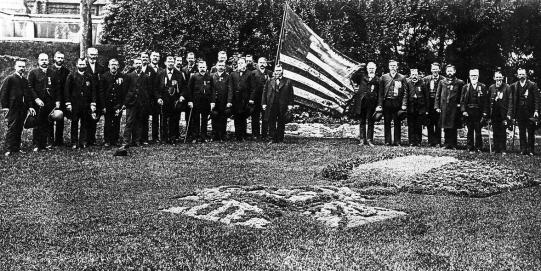
An original copy of this photograph can be viewed at the Drum
Barracks Civil War Museum in Wilmington, California.
Sources:
Books
Adjutant General of the Commonwealth of
Massachusetts. Massachusetts Soldiers. Sailors and Marines in
the Civil War. 8 Vols. Boston: Norwood Press, 1931.
Bensell, Royal A. All Quiet On The Yamhill.
Edited by Gunther Barth. Eugene, Oregon: University of Oregon
Books, 1959.
General Committee of Management, Twentieth
National Encampment. Register of the Department of California,
Grand Army of The Republic. San Francisco, California: Joseph
L. Tharp, 1886.
Hand, George. The Civil War in Apacheland. Edited by Neil B. Carmony.
Silver City, New Mexico: High-Lonesome Books, 1996.
Harpending, Asbury. The Great Diamond Hoax.
Edited by James H. Wilkins. San Francisco: The James Barry Co.,
1913.
Humphreys, Charles A. Field, Camp, Hospital
and Prison in the Civil War, 1863-1865 Boston: Press of Geo. H.
Ellis Co., 1918.
Hunt, Aurora. The Army of the Pacific 1860-1866. Glendale, California:
The Arthur H. Clark Company, 1950.
Lewis, Oscar. The War in the Far West. Garden
City, New York: Doubleday & Company, inc., 1961.
Madden, David. Editor. Beyond the Battlefield.
New York, New York: Simon & Schuster, 2000.
McDowell, Donald. The Beat of the Drum.
Santa Anna, California: Graphic: Publishers, 1993.
McLean, James California Sabers. Bloomington, Indiana: Indiana
University Press, 2000.
Munson, John W. Reminiscences of a Mosby
Guerrilla. New York: Moffat, Yard And Company, 1906.
Orton, Richard H. comp. Records of California
Men in the War of the Rebellion, 1861 To 1865. Sacramento, California:
State Printing Office, 1890.
Rice, William B. The Los Angeles Star 1851-1864.
Edited by John Walton Caughey.
Berkeley and Los Angeles, California: University of California
Press: 1947.
Robinson, John W. Los Angeles in Civil War
Days 1860-65. Los Angeles, California:
Dawson's Book Shop, 1977.
Talbott, Laurence Fletcher. California in
the War For Southern Independence. Los Angeles, California:
Hale and Co., 1996.
Ward, William H., editor. Records of Members
of the Grand Army of the Republic. San Francisco, California:
H.S. Crocker & Co., 1886.
War Department. The War of the Rebellion:
A Compilation of the Official Records of the Union and Confederate
Armies. 128 volumes Washington, D.C.: U.S. Government Printing
Office, 1880-1901.
Wert, Jeffry D. Mosby's Rangers. New York,
New York: Simon & Schuster, 1990.
Williamson, James J. Mosby's Rangers. New
York, New York: Ralph B Kenyon, 1896. Reprint, Time Life
Books, 1982.
Young. San Francisco-A History of the Pacific
Coast Metropolis. (Chapter XXXVI. San Francisco's Attitude During
The Civil War). 1912.
Magazines and Periodicals
Chandler, Robert J. San Franciscans View
the Civil War. Salvo: Journal of the Fort Point and Army Museum
Association. Volume VI, Number 1. Spring 1990.
Chandler, Robert J. The Velvet Glove: The
Army During the Secession Crisis in California, 1860-1861. Journal
of the West. October 1981.
Chandler, Robert J. Vigilante Rebirth: The
Civil War Union League. The Argonaut: Journal of the San Francisco
Historical Society. Volume 3, Number 1. Winter, 1992.
Colwell, Wayne. The California Hundred.
Pacific Historian. Volume 13, Number 3.
Corthell, James Roland. The Story of Camp
Meigs. New England Magazine. Vol. XXXII Number 4. June 1905.
Fitzpatrick, Mike. Jubal Early and the Californians.
Civil War Times Illustrated May 1998.
Kibby, Leo P. California Soldiers in the
Civil War. The California Historical Society Quarterly. December
1961.
Riley, Roger D. California's Role in the
Civil War. California Historian, Fall 1994.
Tibbals, Richard K. Thirty Years Later. Civil War Times Illustrated.
April 1986.
Newspapers
Boston Herald, Boston, Massachusetts. 1863.
Boston Transcript, Boston, Massachusetts.
1863.
Boston Journal, Boston, Massachusetts. 1863.
Boston Saturday Evening Gazette, Boston, Massachusetts. 1863
Daily Alta California, San Francisco, Ca., 1862 - 1865.
Dedham Gazette, Dedham, Massachusetts. 1863.
Evening Buelletn, San Francisco, Ca. 1862-
1864.
The Napa County Reporter. Napa, Ca. 1863.
Diaries and Unpublished Works
Corbett, Samuel J. Diary 1862-1865. Bancroft Library, University
of California, Berkeley.
Dearborn, Valorus. Diary 1864. Privately
owned. Copy at Bancroft Library, University Of California, Berkeley.
Mace, Joanne Beer. Massachusetts Cavalry
from California 1862-1865. A Thesis Presented to Humboldt State
College. August 1967.
Roberts, Charles. Diary 1863.Huntingiton
Library's Manuscript Collection.
Towle, George Washington. Recollections. Bancroft Library, University
of California, Berkeley.
West, Wells. Recollections 1921.
The Web:
http://www.civilwarinteractive.com/wclowell.htm
Gentle Warrior: Charles Russel Lowell, Jr. by Thomas E. Parson
http://2mass.omnica.com
2nd Massachusetts Volunteer Cavalry Web Page hosted by Reunion
Antiques.
http://www.Amazon.com
Parson, Thomas. Bear Flag and Bay state: The Californians of the
Second Massachusetts Cavalry.
http://www.schifferbooks.com
Rogers, Larry. Their Horses Climbed Trees.

